Forkelo guide
The Rotten Tomatoes of food, for the dish not the restaurant.
The Rotten Tomatoes of food is for the dish, not the restaurant. Forkelo publishes one checkable score per plate, then sends you into live rankings.
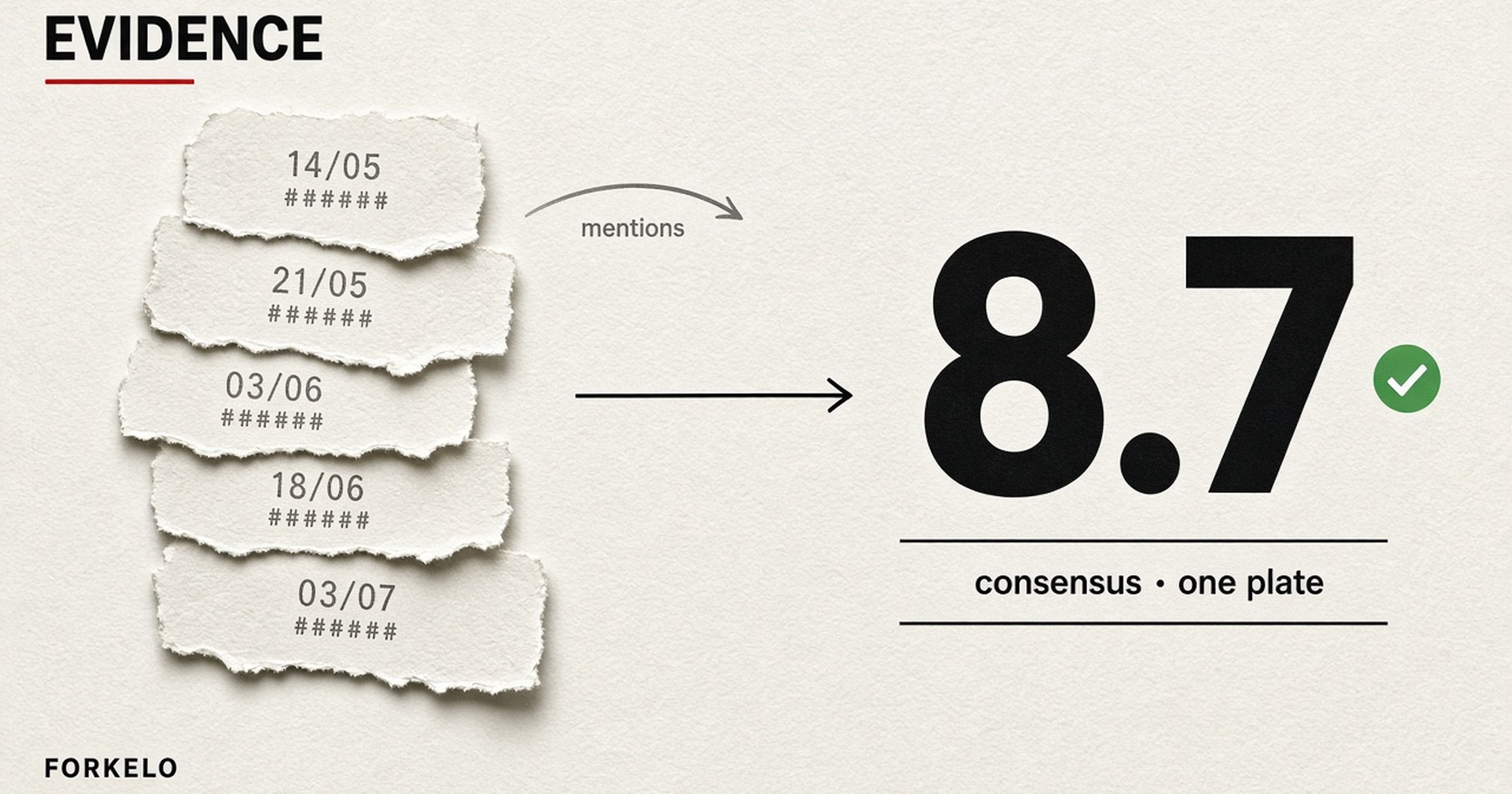
The Rotten Tomatoes of food is not another restaurant-star average. It is a consensus-shaped number for the dish you are actually choosing: for dishes what Rotten Tomatoes is for movies, without pretending a kitchen behaves like a finished print. Films have had that kind of checkable score for a generation. Restaurants have had stars for longer. The plate never did. That gap is what Forkelo is built to fill.
This page is the short pillar. The full arithmetic lives on the methodology page. Who we are is on about. The rankings are the destination.
Why restaurant stars fail when you want one plate
A restaurant rating answers a question almost nobody is asking when they are hungry. It averages the food with the wait, the room, the parking, and the day someone's order was wrong. A 4.6-star place can serve a forgettable burrito. A 3.9-star place with slow service can serve the best one in the county.
The failure is not that stars are "inaccurate." They answer at the wrong level. Averaging over a restaurant throws away the variation you are shopping on: the difference between its dishes. Once that information is gone, no later math can recover it. So Forkelo's founding rule is simple. A restaurant's overall rating is never evidence about a dish, and cannot become an input to a score by any path.
What Forkelo borrows from film consensus, and what it refuses
The ambition is the shape: one checkable number for the thing you are choosing, assembled from many independent voices, that you can argue with. That is the Rotten Tomatoes of food idea applied to a plate.
What Forkelo does not borrow is headcount mechanics. A film-style consensus often turns many critics into a percentage of positive votes. Intensity disappears. "Best of the decade" and "worth a matinee" become the same vote. In food that loss is fatal, because "best smash burger I have had in the South Bay" is not a louder version of "the burger was fine." It is the claim a ranking exists to test.
Forkelo also refuses the quiet badge that says "enough evidence" by its absence. A film with four reviews and a film with four hundred can both look unmarked. Forkelo prints confidence beside the score instead, always, on the same card. It does not copy Certified Fresh-style branding, and it is not a percentage score dressed up as a ranking.
| Film-style consensus shape | Forkelo for a dish | |
|---|---|---|
| Unit | The finished work | One dish at one restaurant |
| Question | How many voices were positive? | How strongly, recently, and widely is this plate recommended? |
| Time | A print does not change | A kitchen does; old mentions decay |
| Thin evidence | Often a silent badge | Confidence printed next to the score |
Forkelo is not claiming to be Rotten Tomatoes. The locked line is only this: for dishes what Rotten Tomatoes is for movies. The score is an estimate. The confidence label is a separate fact about how sure anyone should be.
What goes into a score, in plain English
The atom is a dish-specific mention: one source, saying one thing, about one dish, at one restaurant, on one date. Each mention is read for sentiment and for how strongly it recommends the plate. Mentions fade with an 18-month half-life, because a kitchen is not a finished film. Thin piles of praise are pulled toward a neutral prior so two raves cannot mint a ten. Independent kinds of source agreeing add a small corroboration bonus. Confidence is computed separately from how much evidence weight there is and how many source types show up, then printed beside the number.
None of those constants are re-derived here. Every threshold, worked example, and the nineteen numbers in one table are on the methodology page.
What never enters the number
- Restaurant star ratings
- Review counts, footfall, or popularity
- Price (shown, never scored)
- Anything a restaurant can buy: rank, placement, or a tie-break
- Photographs as a quality signal
- Editorial thumbs or a manual boost field
Distance can be shown. It is never what the ranking sorts on. The list is the same document for everyone who opens it.
How to read a card
A card that says 9.4 · High confidence and a card that says 9.6 · Early ranking are both published on purpose. The first number is how good the dish looks given the evidence. The second is how sure the evidence base is. They are not blended into one fake "adjusted" score.
Early ranking is a to-do item, not a secret demotion. It usually means the dish still needs more research, more source types, or both. The exact thresholds for High, Medium, and Early live on the methodology page so this guide cannot drift out of sync with the code.
Go look at a ranking
The guide's job is to get you into the directory. Start with a plate you already crave:
- Smash burgers in the South Bay
- Tonkotsu ramen in the South Bay
- Tri-tip in the South Bay
- California burritos in the South Bay
Forkelo does not taste the food. Researchers file dated, dish-specific mentions; the score is a pure function of those rows. If a ranking looks thin, the fix is more evidence, not a quieter number. More on who builds this is on about. More guides live at /guides.
A few straight answers
What is the Rotten Tomatoes of food?
A consensus-shaped score for one dish at one restaurant, not an average over everything a restaurant does. Forkelo's version is for dishes what Rotten Tomatoes is for movies: one checkable number from many independent voices, aimed at the plate you are choosing.
How is a Forkelo Score different from restaurant stars?
Stars average the whole visit. A Forkelo Score only reads dish-specific mentions. Restaurant ratings never enter the number, even as a tie-break or a prior.
How is it different from a Tomatometer?
A Tomatometer-style score is usually a headcount: the share of voices that were positive. Forkelo weighs how strongly and how recently a plate is recommended, decays old kitchen mentions, and prints confidence beside the score instead of a silent quality badge. It does not use Tomatometer or Certified Fresh branding, and the ranking is not a percentage.
What goes into the score?
Dated, dish-only mentions: sentiment, recommendation strength, recency with an 18-month half-life, shrinkage when evidence is thin, a small bonus when independent source types agree, and a separate confidence label. Full constants and worked examples are on the methodology page.